When designing any technology intervention, I try and incorporate the following skills from the graduate profile:
Develop an understanding and appreciation of current issues and debates in the field;
Develop the capacity to locate, evaluate and use the information effectively;
Make appropriate use of advanced information and communication technologies; and
Work independently and in collaboration with others.
With the rise of Web 2.0 (social technologies), it becomes essential for teachers to scaffold collaborative learning mediated through technologies in relevant contexts. This provides students with (1) an experience of the collaborative process online, including familiarity with the technology e.g. wiki, (2) exposure to etiquette online (netiquette) and (3) awareness of the challenges that influence good collaboration and the quality of the output e.g. copyright.
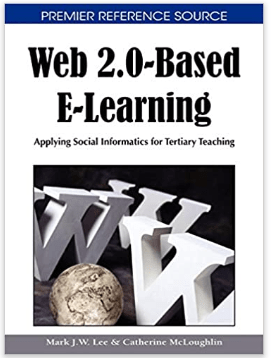
Lee, M. J. W. & McLoughlin, C. (Eds.). (2011). Web 2.0 based elearning: applying social informatics for tertiary teaching. Hershey, PA: Information Science Reference.
Use of Web 2.0* tools in contemporary tertiary education is debatable. While technology advocates (e.g. Marc Prensky) recommend blanket adoption; researchers (see Kennedy et al. 2010) are concerned about the adaptability of social technologies in educational contexts. This book, through various authors, and their respective contexts, provides an informed and balanced view with sections dedicated to theory, practice and future directions of the educational application of Web 2.0 tools.
Book reviewed: Web 2.0 based elearning
The first section covers emerging paradigms and innovative theories in web-based tertiary teaching since Web 2.0 tools and practices are challenging and redefining scholarship and pedagogy. The idea is that the emergence of new tools by itself will not revolutionise education but its affordances provide the opportunity to: a) create new models for education for the knowledge society and, b) innovate tertiary teaching and learning.
Affordances of Web 2.0 tools are well illustrated through case studies and exemplars of evidence-based practices in section two. As a practitioner, this section was most useful for me. The authors refrain from pushing the technology agenda but address the important decision making questions like what to use, how and when. Pedagogical relevance is emphasised with reference to learners’ digital literacies and personal knowledge management skills and teachers’ capabilities and capacities.The final section addresses the challenges in educational applications of Web 2.0 due to the theoretical gap in literature and concludes with two approaches to harnessing the power of Web 2.0 in education: 1. Applying social web practices to facilitate greater dialogue and sharing of learning and teaching ideas. 2. Using metaphors as a mechanism for understanding educational application of Web 2.0 technologies. Overall, this book is a great reference for anyone contemplating the use of Web 2.0 tools in education hence a valuable addition to the reading list.
*A second generation, more personalised, communicative form of the World Wide Web that emphasizes active participation, connectivity, collaboration, and sharing of knowledge and ideas among users. Also referred to as the “read/write Web” (Price, 2006; Richardson, 2006).
Social networking and its impact on students and education
This was my first overseas seminar since joining the University of Auckland as an academic in Technology Enhanced Learning. The seminar – focused on social networking – began with Dr. Dahle Suggett raising important issues around social networking and its impact on the social and emotional wellbeing of our youth. According to him, social networking begins a new era of cultural management where it becomes essential for educators and school administrators to plan the management of the social aspects of technologies. Many schools and universities end up blocking the access to tools such as ‘YouTube’ and ‘MySpace’. Is this the right approach? How do schools respond to students’ use of advanced technologies?
Affordances of Web 2.0
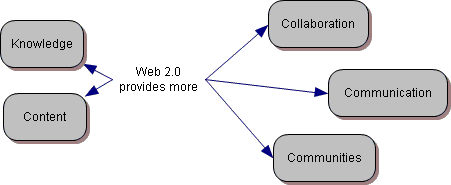
Keynote by danah boyd Networked publics concept began with the inception of Usenet in 1979. Web 2.0 has provided more opportunity for networking in the public sphere with the use of modern social networking tools.
 Ashwini Datt