A recent article by Smith, Kahlke and Judd (2020), reminds me of how almost a decade ago now, a colleague and I created an engaging learning design for a competency based programme: combining technology affordances, pedgagogy and digital literacy. We went the extra mile in planning and designing for the proper integration and use of technologies in the Pharmacy Practice programme, without making any assumptions about students’ digital literacy. Our approach (see Datt & Aspden, 2011) was based on the contributing elements of design for socio-constructivist learning environments: authenticity, motivation, scaffolding and skills development. We too focused on “two key questions: (1) what affordances are offered by a given technology that will support learners in developing their professional competencies, and (2) what broad range of knowledge and skills do learners require in order to effectively integrate a technology in their learning and practice?” (Smith et al., 2020, p.6)
We have all been compelled to consider remote learning as a legitimate alternative to on-campus teaching. For the advocates of technology integrated learning (fully online or blended) – who have chipped away at good designs for learning with educational technologies – it was a triumph and a long time coming. Educators who were yet to be convinced about the possibilities of online or digital learning, quickly adopted remote learning opportunities out of necessity. How did we achieve such a feat? Be it new ways of delivering or facilitating learning, we all had to build our capacity to do so in a short period of time. Welcome the #pivotonline movement.
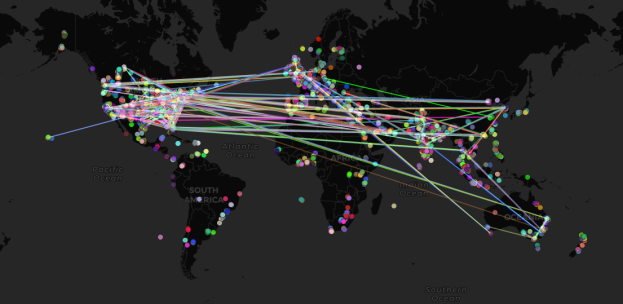
#Pivotonline is my doctoral research playing out in real-time, educators networking to build their capacity for teaching with technologies. If we consider a platform like Twitter, we can see how these networks form and flourish – with short and long term connections. The image here is of the publicly available Tweets using pivotonline hashtag. What do these connections mean and what value do they hold for the educators involved? What benefits and challenges did these new ways of learning present for our students?
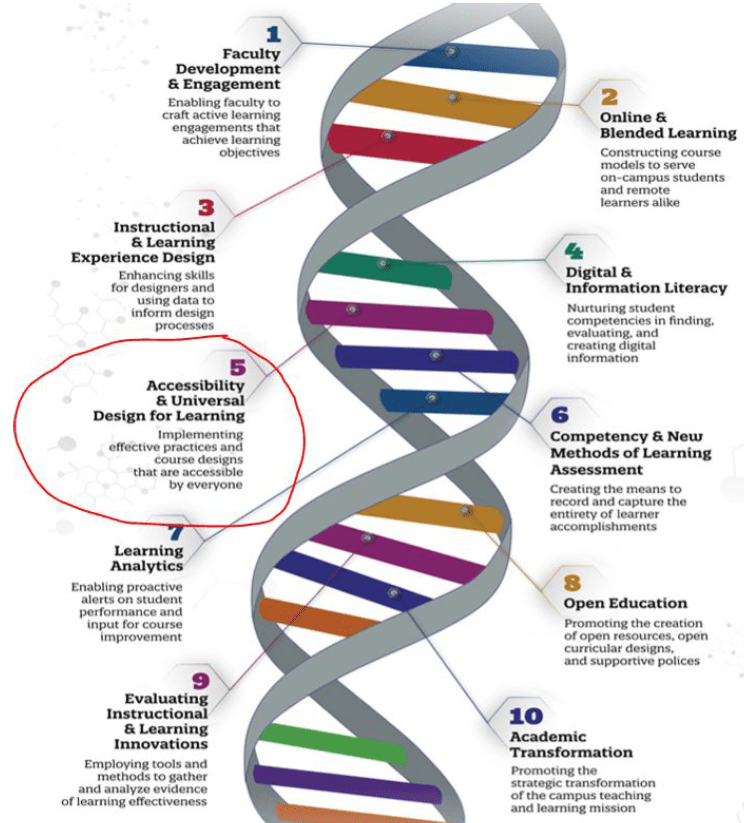
What can technology do to create barriers to learning? Seems like plenty… EDUCAUSE in its 2019 elearning initiative, identified accessibility and Universal Design for Learning (UDL) as a key teaching and learning issue. Our presentation (2019 Scholarship of Technology Enhanced Learning conference) on the core consideration for inclusivity in design – audience, tools, content and legislation – opened up some interesting discussions. Many at times we make assumptions about our learners and their digital skills; accessibility and usability of tools; content creation quailty (re-packaging rather than re-purposing) and the law (accessibility standards). How can we ensure that our learning designs and content facilitation through technology offers equitable learning experiences?
What do our learners find useful?
Even though students in Australia and New Zealand report high levels of digital activity than UK students, they agree that technology can have negative impacts on their studies. Unless designed well and integrated into the core learning outcomes, these learners rather not have digital technologies used in their courses (Beetham, Newman & Knight, 2019).
What tools are useful?
The use of digital technologies don’t always lead to creative, collaborative, participatory and hyper-connected practices. Henderson, Selwyn and Aston (2017) indicate that rather these are the activities, practices and processes that students feel compelled to undertake in order to ‘do’ university.
...many of the reportedly ‘educational’ benefits of digital technology…are more accurately described as concerned with the ‘logistics’ of university study rather than matters related directly to ‘learning’ per se.
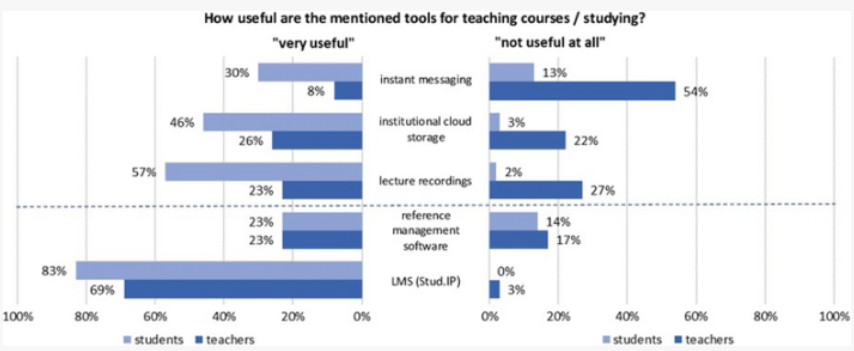
Bond, Marín, Dolch, et al. (2018) reported differences in how learners and teachers perceive the usefulness of tools such as lecture recordings, the learning management system (LMS) and reference management systems. For example, close to a quarter of all teachers they researched, thought lecture recordings were not useful but close to 50% of the students found them useful.
Comparison of teaching and learning tools (Bond, Marín, Dolch, et al. (2018)
What guidelines apply for accessible and intuitive content development?
Reflecting on my experience in ACADPRAC 704: Research Writing – a course which is part of my PGCert Academic Practice journey.
Introduction Most important concerns of my early career publishing are the confidence to express my ‘voice’ and develop a preferred style. Part of the issue is having the ability to identify and capitalise on the existing strengths of my writing. The journey in ACADPRAC 704 became the rite of passage into writing for me. Taking a bullet train to arrive at the destination much quicker than what the usual journey would have taken. As a budding writer, I had three objectives: To make use of the increased awareness of research writing – politics, pleasure and style – and develop as a research writer. To develop a template for my style and a psychological approach to publication that will boost my confidence and success in publishing. To join a community of practice (CoP) within 704 and/or the Centre for Learning and Research in Higher Education (CLeaR) to become more disciplined and productive in writing through support, advice and feedback.
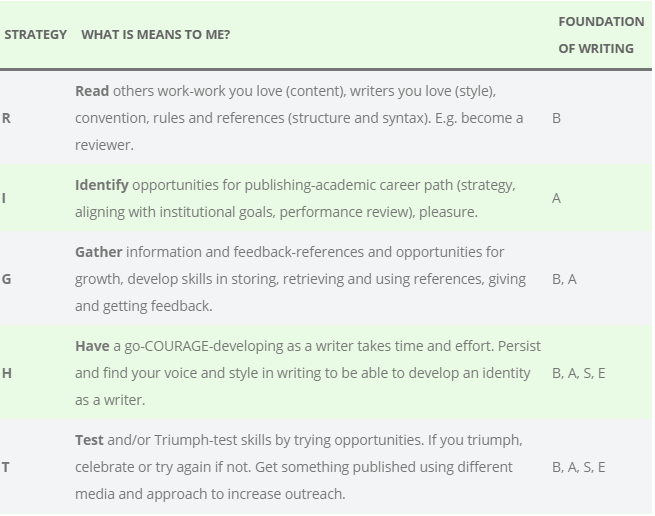
Aligning my strategy (RIGHT) to the foundations (BASE) of writing. Key: B-behavioural, A-artisanal, S-social, E-emotional
A search on writing, dressing and style, revealed a rather humorous, unrelated article on styling and dressing, in the sense of, you guessed it, fashion! What resonated with me, however, was the implied message in the article. Irrespective of the designer style or label, the height of the wearer has an impact on the overall impression of the garment. Much like the stage we are at in our research career, has an influence on the liberty we have to make bold statements with our writing. This post is very much a reflection of my own writing journey, not research writing per se but writing in general.
 Ashwini Datt