Excited to be developing a new fully online special topic paper for the UoA #clined programme on advanced elearning in clinical education. This paper intends to amalgamate the lessons learnt from remote teaching/learning during #covid19pandemic, with more established and tested means of technology integration in clinical teaching. There are so many reasons why the timing is opportune. A curriculum framework transformation is underway at the university, #pivotonline has surfaced promising options to interact and engage with students flexibly and the best way to appreciate learning online is to step into an online learner’s shoe. Not all changes implemented during #pivotonline may be suitable in perpetuity but there are aspects of online learning that might enable useful pedagogical shift in medical education.
What remains to be seen is whether COVID-19 provided the experience, vision and courage for medical education to change, or whether the old barriers will rise again when the pandemic is over.
We have all been compelled to consider remote learning as a legitimate alternative to on-campus teaching. For the advocates of technology integrated learning (fully online or blended) – who have chipped away at good designs for learning with educational technologies – it was a triumph and a long time coming. Educators who were yet to be convinced about the possibilities of online or digital learning, quickly adopted remote learning opportunities out of necessity. How did we achieve such a feat? Be it new ways of delivering or facilitating learning, we all had to build our capacity to do so in a short period of time. Welcome the #pivotonline movement.
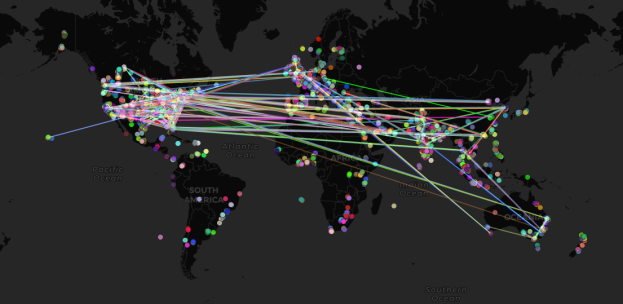
#Pivotonline is my doctoral research playing out in real-time, educators networking to build their capacity for teaching with technologies. If we consider a platform like Twitter, we can see how these networks form and flourish – with short and long term connections. The image here is of the publicly available Tweets using pivotonline hashtag. What do these connections mean and what value do they hold for the educators involved? What benefits and challenges did these new ways of learning present for our students?
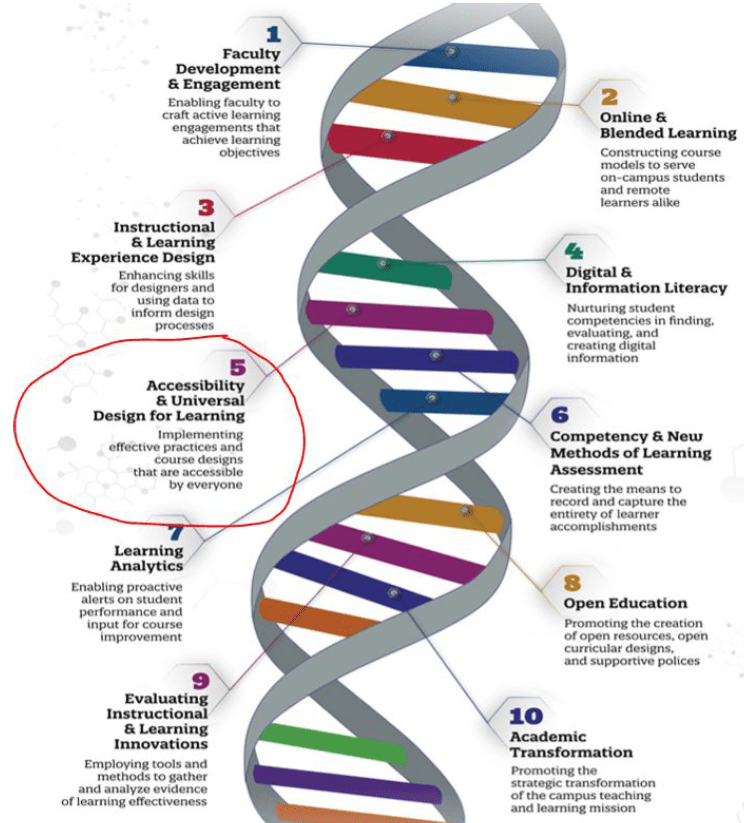
What can technology do to create barriers to learning? Seems like plenty… EDUCAUSE in its 2019 elearning initiative, identified accessibility and Universal Design for Learning (UDL) as a key teaching and learning issue. Our presentation (2019 Scholarship of Technology Enhanced Learning conference) on the core consideration for inclusivity in design – audience, tools, content and legislation – opened up some interesting discussions. Many at times we make assumptions about our learners and their digital skills; accessibility and usability of tools; content creation quailty (re-packaging rather than re-purposing) and the law (accessibility standards). How can we ensure that our learning designs and content facilitation through technology offers equitable learning experiences?
What do our learners find useful?
Even though students in Australia and New Zealand report high levels of digital activity than UK students, they agree that technology can have negative impacts on their studies. Unless designed well and integrated into the core learning outcomes, these learners rather not have digital technologies used in their courses (Beetham, Newman & Knight, 2019).
What tools are useful?
The use of digital technologies don’t always lead to creative, collaborative, participatory and hyper-connected practices. Henderson, Selwyn and Aston (2017) indicate that rather these are the activities, practices and processes that students feel compelled to undertake in order to ‘do’ university.
...many of the reportedly ‘educational’ benefits of digital technology…are more accurately described as concerned with the ‘logistics’ of university study rather than matters related directly to ‘learning’ per se.
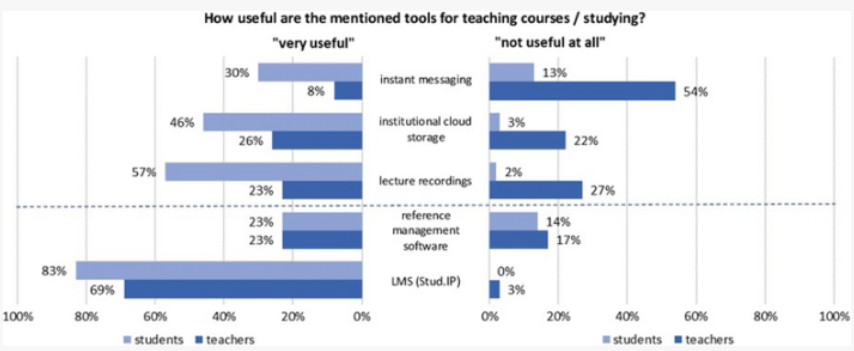
Bond, Marín, Dolch, et al. (2018) reported differences in how learners and teachers perceive the usefulness of tools such as lecture recordings, the learning management system (LMS) and reference management systems. For example, close to a quarter of all teachers they researched, thought lecture recordings were not useful but close to 50% of the students found them useful.
Comparison of teaching and learning tools (Bond, Marín, Dolch, et al. (2018)
What guidelines apply for accessible and intuitive content development?
I recently presented at the International Society for the Scholarship of Teaching and Learning (ISSOTL) and Tertiary Education Research New Zealand (TERNZ) conferences on my experience with connectivist, massive open online courses (MOOCs). The experiment with setting up and facilitating a mini open online component (mooc) of a course turned into a “connectivist disconnect.”
References:
Datt, A. (2014). The Connectivist Disconnect. Paper presented at Tertiary Education Research in New Zealand (TERNZ), Auckland, New Zealand. 26 November – 28 November 2014. [Online] Datt, A. K. (2014). Casting a connectivist stone to generate networking ripples-cMOOCs and elearning professional development. Paper presented at International Society for the Scholarship of Teaching and Learning Conference, Quebec City, Canada. 22 October – 25 October 2014. Nurturing Passion and Creativity in Teaching and Learning. [Online]
Just noticed that I have not yet written any reflections from April. Possibly the most busiest time for me so far in this semester. Had the second synchronous session today which was very successful indeed. The ifree recorder for Skype is a good tool for recording and distribution of live Skype sessions. I am so happy for the following positive feedback on the course:
Rubric for communication/participation is a useful guidance according to the students. Peer review exercise was useful though the tool PeerMark was not very intuitive to use. The theoretical concepts and models introduced in the learning spaces topic e.g. 5 stage model, conversational framework, ADDIE, OTARA and SECTIONS were considered really effective in planning for technology integration. It has made participants consider the rationale for technology integration rather than just the mere availability being an advantage or a per-requisite for use in teaching and learning.
Participants are finding the strategies and tactics used in ACADPRAC 703 really useful for their teaching!

 Ashwini Datt