A search on writing, dressing and style, revealed a rather humorous, unrelated article on styling and dressing, in the sense of, you guessed it, fashion! What resonated with me, however, was the implied message in the article. Irrespective of the designer style or label, the height of the wearer has an impact on the overall impression of the garment. Much like the stage we are at in our research career, has an influence on the liberty we have to make bold statements with our writing. This post is very much a reflection of my own writing journey, not research writing per se but writing in general.
Apart from all the enrollment concerns, I have begun to feel that most of the students are yet to feel confident online. At least one of them is fully engaged (having completed their student page!) and raring to go while the rest are very cautious. It is hard to find the balance between catering to the needs of the very active and those who are lurking not because they don’t want to engage but just haven’t found the confidence to put their thoughts out there. A good last minute teaching strategy for me was to hold back the summary of topic 1 until all students have had a go at the readings and have posted a response to the online activity. Have decided to publish the announcements using the comments feature as it is auto subscribed. There was bit of a drama over where it should appear on the site and whether the comments bubble should be active when it is on the homepage. We tried to suppress the bubble but realised that the ajax code does not behave and the like button disappears after the first person has used it! Now, a dedicated page called announcements has been created and that has the full comment feature.
When designing any technology intervention, I try and incorporate the following skills from the graduate profile:
Develop an understanding and appreciation of current issues and debates in the field;
Develop the capacity to locate, evaluate and use the information effectively;
Make appropriate use of advanced information and communication technologies; and
Work independently and in collaboration with others.
With the rise of Web 2.0 (social technologies), it becomes essential for teachers to scaffold collaborative learning mediated through technologies in relevant contexts. This provides students with (1) an experience of the collaborative process online, including familiarity with the technology e.g. wiki, (2) exposure to etiquette online (netiquette) and (3) awareness of the challenges that influence good collaboration and the quality of the output e.g. copyright.
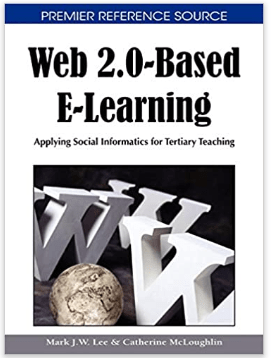
Lee, M. J. W. & McLoughlin, C. (Eds.). (2011). Web 2.0 based elearning: applying social informatics for tertiary teaching. Hershey, PA: Information Science Reference.
Use of Web 2.0* tools in contemporary tertiary education is debatable. While technology advocates (e.g. Marc Prensky) recommend blanket adoption; researchers (see Kennedy et al. 2010) are concerned about the adaptability of social technologies in educational contexts. This book, through various authors, and their respective contexts, provides an informed and balanced view with sections dedicated to theory, practice and future directions of the educational application of Web 2.0 tools.
Book reviewed: Web 2.0 based elearning
The first section covers emerging paradigms and innovative theories in web-based tertiary teaching since Web 2.0 tools and practices are challenging and redefining scholarship and pedagogy. The idea is that the emergence of new tools by itself will not revolutionise education but its affordances provide the opportunity to: a) create new models for education for the knowledge society and, b) innovate tertiary teaching and learning.
Affordances of Web 2.0 tools are well illustrated through case studies and exemplars of evidence-based practices in section two. As a practitioner, this section was most useful for me. The authors refrain from pushing the technology agenda but address the important decision making questions like what to use, how and when. Pedagogical relevance is emphasised with reference to learners’ digital literacies and personal knowledge management skills and teachers’ capabilities and capacities.The final section addresses the challenges in educational applications of Web 2.0 due to the theoretical gap in literature and concludes with two approaches to harnessing the power of Web 2.0 in education: 1. Applying social web practices to facilitate greater dialogue and sharing of learning and teaching ideas. 2. Using metaphors as a mechanism for understanding educational application of Web 2.0 technologies. Overall, this book is a great reference for anyone contemplating the use of Web 2.0 tools in education hence a valuable addition to the reading list.
*A second generation, more personalised, communicative form of the World Wide Web that emphasizes active participation, connectivity, collaboration, and sharing of knowledge and ideas among users. Also referred to as the “read/write Web” (Price, 2006; Richardson, 2006).
Digitool, an existing digital repository that is available through the University Library is currently being trialled. Initially it will be used to store and catalogue a range of digital resources around the teaching themes for use in BIOSCI100 & 100G. The Dublin core is used to standardise the metadata descriptors. In designing the digital repository, the team is mindful of issues around copyright and access. The project will investigate the potential of this repository as a teaching resource and the practicality of maintaining and building on such a system in the longer term. It will also consider the long term costs for investment in such a system and likely usage by the staff within the School of Biological Sciences.
 Ashwini Datt