Tag Archives: citizenship

knowledge and skills to use technology appropriately

Digital citizenship

Thinking about Online identity, Professional social networks, Research profiles or your institutional policy on social media?

The constitution of citizenship is up for debate in this era of rapid technological change. Technology can equally well facilitate good or bad citizenship, and there are many reasons to argue that it does not create a neutral or democratic environment. Rules of social engagement, knowledge creation and ownership are shifting. One argument is that most academics come from a generation referred to as ‘digital immigrants’ and are expected to teach ‘digital natives’, and so it would be likely for these natives to get restless – frustrated by their teachers’ and institutions’ misuse or lack of use of the social networking tools and concepts that are everyday features of their lives. But is this the case? Researchers like Bennett & Maton (2010) have debunked the idea of digital natives/immigrants a decade ago. So what constitutes ‘good citizenship’ in this environment? Any discussion of digital citizenship should focus on two broad questions:

How is Internet technology fuelling educational and social change, and in what ways does this challenge and facilitate concepts of citizenship in the current context?
How should teachers and institutions respond to the ‘digital’ demands?

Defining digital citizenship
An ability to practice and advocate online behavior that demonstrates legal, ethical, safe, and responsible uses of information and communication technologies (Greenhow & Ribble, 2009, p. 125).
Digital citizenship represents capacity, belonging, and the potential for political and economic engagement in society in the information age. Digital citizens practice conscientious use of technology, demonstrate responsible use of information, and maintain a positive attitude to learning with technology. (Alam & McLoughlin, 2010, p14)

Developing digital citizenship
Some of the issues that arise are: digital persona (professional and personal), privacy, participation (in politics and society) and liberation/democracy (massification of education). How do we manage our identity as educators in the age of open and massive education and how do we define the rules of engagement with digital media? Netiquette is one way of building awareness of the code of conduct online but does digital citizenship support academic freedom? One thing we tend to forget is that we don’t need to share everything, we have control over the amount and type of information we share. The interaction equivalency theorem shows what the reality of educational communication and interaction is in today’s day and age. Alam & McLoughlin discussed how educators are grasping the concept of digital citizenship in formal courses a decade ago.
ITEL: inclusive technology enhanced learning

Related project: Technology for equitable learning opportunities and design
(Learning Enhancement Grant 2019-2020)

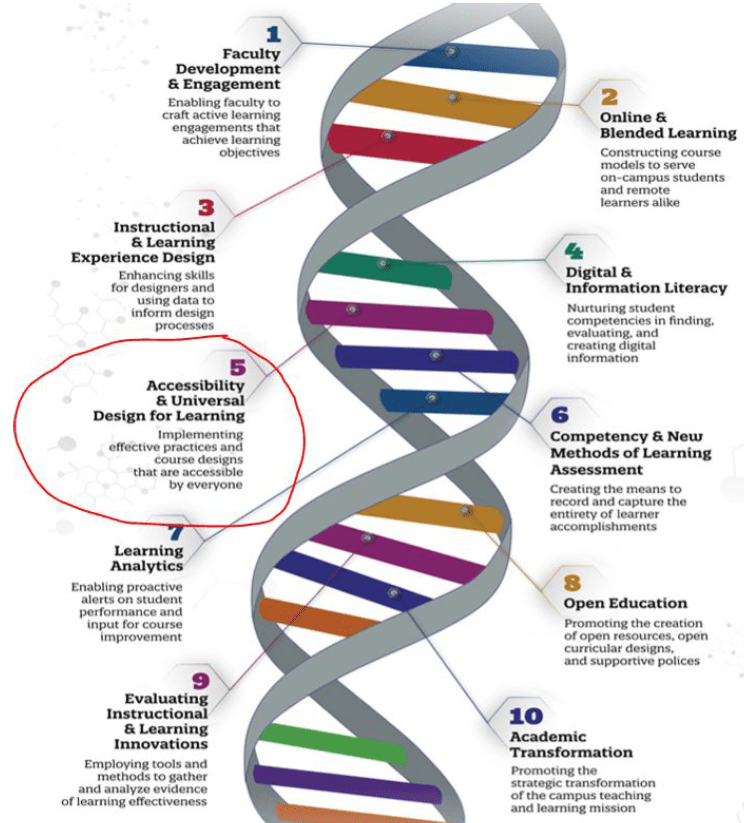
Top 10 issues in higher education in 2019 (EDUCAUSE)

What can technology do to create barriers to learning? Seems like plenty… EDUCAUSE in its 2019 elearning initiative, identified accessibility and Universal Design for Learning (UDL) as a key teaching and learning issue. Our presentation (2019 Scholarship of Technology Enhanced Learning conference) on the core consideration for inclusivity in design – audience, tools, content and legislation – opened up some interesting discussions. Many at times we make assumptions about our learners and their digital skills; accessibility and usability of tools; content creation quailty (re-packaging rather than re-purposing) and the law (accessibility standards). How can we ensure that our learning designs and content facilitation through technology offers equitable learning experiences? 

What do our learners find useful?

Even though students in Australia and New Zealand report high levels of digital activity than UK students, they agree that technology can have negative impacts on their studies. Unless designed well and integrated into the core learning outcomes, these learners rather not have digital technologies used in their courses (Beetham, Newman & Knight, 2019).

What tools are useful?

The use of digital technologies don’t always lead to creative, collaborative, participatory and hyper-connected practices. Henderson, Selwyn and Aston (2017) indicate that rather these are the activities, practices and processes that students feel compelled to undertake in order to ‘do’ university.

...many of the reportedly ‘educational’ benefits of digital technology…are more accurately described as concerned with the ‘logistics’ of university study rather than matters related directly to ‘learning’ per se.

Henderson, Selwyn & Aston (2017)

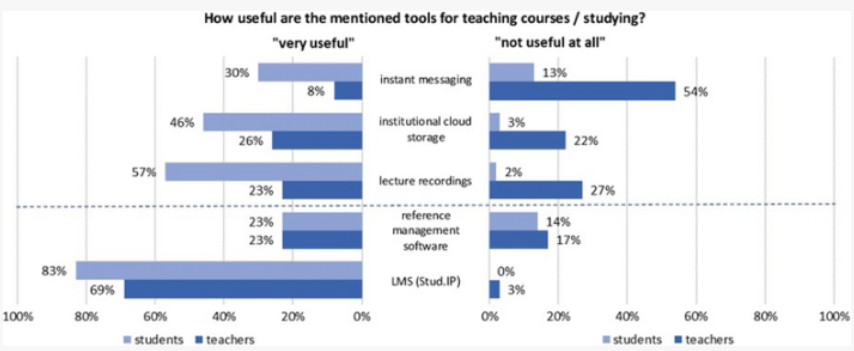
Bond, Marín, Dolch, et al. (2018) reported differences in how learners and teachers perceive the usefulness of tools such as lecture recordings, the learning management system (LMS) and reference management systems. For example, close to a quarter of all teachers they researched, thought lecture recordings were not useful but close to 50% of the students found them useful.

Comparison of teaching and learning tools (Bond, Marín, Dolch, et al. (2018)

What guidelines apply for accessible and intuitive content development?

Web content accessibility guidelines (WCAG 2.1/W3C)
European Union accessibility act
Web accessibility guidelines (Australia)
Proposed changes to web standards (New Zealand)

Generation “MySpace”

Social networking and its impact on students and education

This was my first overseas seminar since joining the University of Auckland as an academic in Technology Enhanced Learning. The seminar – focused on social networking – began with Dr. Dahle Suggett raising important issues around social networking and its impact on the social and emotional wellbeing of our youth. According to him, social networking begins a new era of cultural management where it becomes essential for educators and school administrators to plan the management of the social aspects of technologies. Many schools and universities end up blocking the access to tools such as ‘YouTube’ and ‘MySpace’. Is this the right approach? How do schools respond to students’ use of advanced technologies?

Affordances of Web 2.0

Keynote by danah boyd
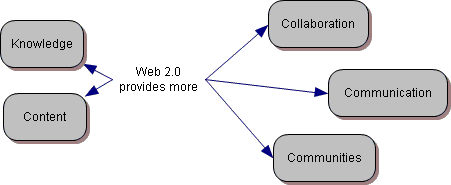
Networked publics concept began with the inception of Usenet in 1979. Web 2.0 has provided more opportunity for networking in the public sphere with the use of modern social networking tools.

Continue reading