
Tag Archives: capacity

ability to engage purposefully

Covid19, networks and capacity to teach with tech

We have all been compelled to consider remote learning as a legitimate alternative to on-campus teaching. For the advocates of technology integrated learning (fully online or blended) – who have chipped away at good designs for learning with educational technologies – it was a triumph and a long time coming. Educators who were yet to be convinced about the possibilities of online or digital learning, quickly adopted remote learning opportunities out of necessity. How did we achieve such a feat? Be it new ways of delivering or facilitating learning, we all had to build our capacity to do so in a short period of time. Welcome the #pivotonline movement.

#pivotonline resources:
Twitter; #pivotonline
AACE: Stories from the field ebook
Linkedin group: Moving HE teaching online
Online Learning Consortium: Faculty Playbook
Coursera: Learning to teach online
OpenLearn: Take your teaching online
Youtube: Open teach
University of Auckland: Remote learning
Googledoc: Hybrid learning; Higher Ed Guidance
Public network: Keep teaching
Blog: Edvisor community
Global support group: #OER4Covid
Asian Journal of Distance Education: Diverse perspectives
EDUCAUSE: Teaching continuity

#Pivotonline is my doctoral research playing out in real-time, educators networking to build their capacity for teaching with technologies. If we consider a platform like Twitter, we can see how these networks form and flourish – with short and long term connections. The image here is of the publicly available Tweets using pivotonline hashtag. What do these connections mean and what value do they hold for the educators involved? What benefits and challenges did these new ways of learning present for our students?
The RIGHT to write

Reflecting on my experience in ACADPRAC 704: Research Writing – a course which is part of my PGCert Academic Practice journey.

Introduction
Most important concerns of my early career publishing are the confidence to express my ‘voice’ and develop a preferred style.  Part of the issue is having the ability to identify and capitalise on the existing strengths of my writing. The journey in ACADPRAC 704 became the rite of passage into writing for me. Taking a bullet train to arrive at the destination much quicker than what the usual journey would have taken. As a budding writer, I had three objectives:
To make use of the increased awareness of research writing – politics, pleasure and style – and develop as a research writer.
To develop a template for my style and a psychological approach to publication that will boost my confidence and success in publishing.
To join a community of practice (CoP) within 704 and/or the Centre for Learning and Research in Higher Education (CLeaR) to become more disciplined and productive in writing through support, advice and feedback.

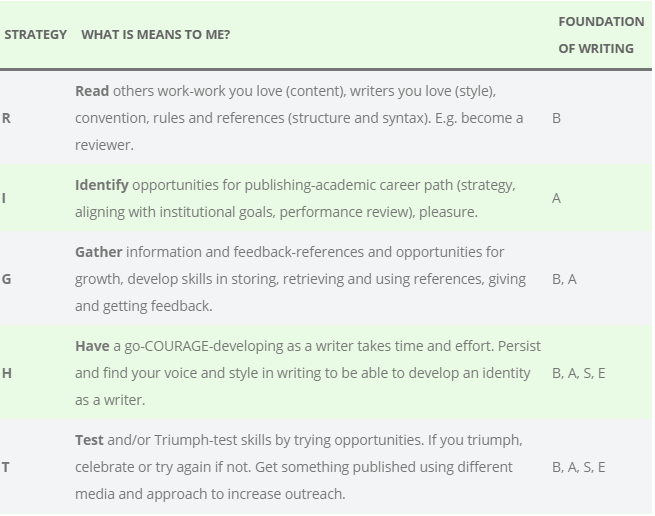
Aligning my strategy (RIGHT) to the foundations (BASE) of writing. Key: B-behavioural, A-artisanal, S-social, E-emotional
Continue reading

TEL tests the seasoned

I recently presented at the International Society for the Scholarship of Teaching and Learning (ISSOTL) and Tertiary Education Research New Zealand (TERNZ) conferences on my experience with connectivist, massive open online courses (MOOCs). The experiment with setting up and facilitating a mini open online component (mooc) of a course turned into a “connectivist disconnect.”

References:

Datt, A. (2014)The Connectivist Disconnect. Paper presented at Tertiary Education Research in New Zealand (TERNZ), Auckland, New Zealand. 26 November – 28 November 2014. [Online]
Datt, A. K. (2014)Casting a connectivist stone to generate networking ripples-cMOOCs and elearning professional development. Paper presented at International Society for the Scholarship of Teaching and Learning Conference, Quebec City, Canada. 22 October – 25 October 2014. Nurturing Passion and Creativity in Teaching and Learning. [Online]

Continue reading

Strategies to engage online

While hastily trying to finish off a proposal on the mooc course design and challenges (which will influence the design itself) for a book chapter,  I’ve come to a realisation that my online students (fellow academics) are not really present in the course. Yes, they log in and out and do post a few messages sporadically in response to the activities, I still am not getting the level of engagement I would like. Going back to my masters research on the types and levels of interaction within the course, I am a bit worried if this group will do well on a collaborative task. Therefore, I have planned a synchronous session that will help me develop more of a presence and be the facilitator of learning in the course. I have invited students to join in with questions etc and also come prepared to summarise the first topic of digital citizenship. I will record the session for the benefit of others in the course.

Reading on the MOOCs phenomenon and the diverse ways in which learners and teachers alike respond to it, is very intriguing at this stage as I plan the implementation of the 703 mooc. A meeting with the copyright officer and the library liaison is high on the cards as I need to clarify what is acceptable and can be legally shared through the mooc. The pieces of the theoretical puzzle are slowly getting solved as I discover more literature on the pedagogy of MOOCs.

MERLOT Journal of Online Teaching and Learning and MOOCs forum seem to be excellent sources of information on the current status and application of the MOOCs initiative. What’s also reassuring is that cMOOCs and their design is what is relevant in my approach to mooc design, development, implementation and integration in ACADPRAC 703. cMOOCs are influenced by well known learning theories and concepts such as Socio-constructivism that has its roots in social learning, Connectivism that is informed by network theory and Community of Practice (CoP) model that is relevant in academic professional development initiatives.

Dressing and styling

A search on writing, dressing and style, revealed a rather humorous, unrelated article on styling and dressing, in the sense of, you guessed it, fashion! What resonated with me, however, was the implied message in the article. Irrespective of the designer style or label, the height of the wearer has an impact on the overall impression of the garment. Much like the stage we are at in our research career, has an influence on the liberty we have to make bold statements with our writing. This post is very much a reflection of my own writing journey, not research writing per se but writing in general.

Continue reading