Tag Archives: accessible

design of accessible learning environments and initiatives

ITEL: inclusive technology enhanced learning

Related project: Technology for equitable learning opportunities and design
(Learning Enhancement Grant 2019-2020)
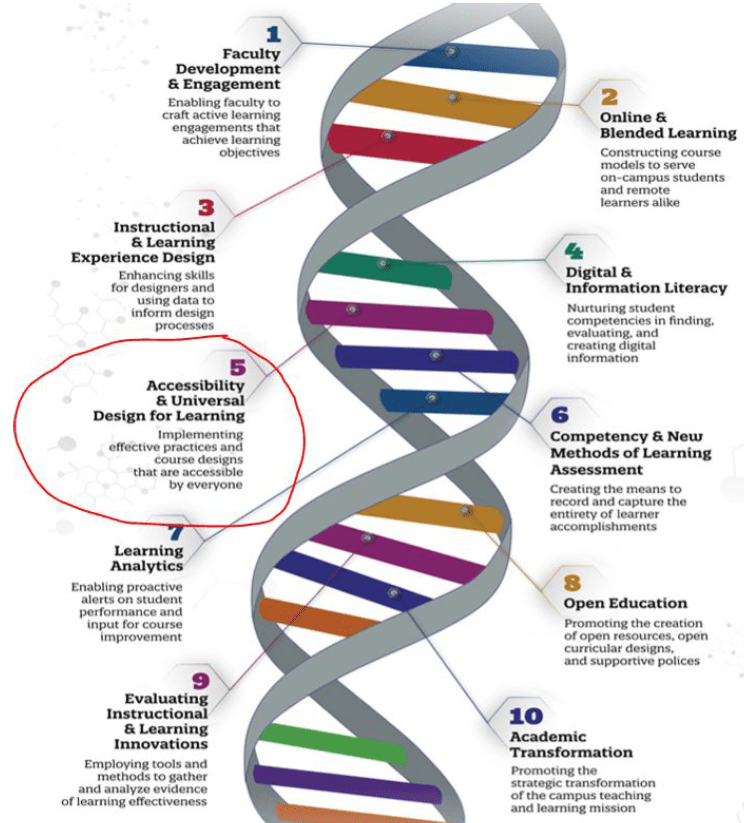
Top 10 issues in higher education in 2019 (EDUCAUSE)

What can technology do to create barriers to learning? Seems like plenty… EDUCAUSE in its 2019 elearning initiative, identified accessibility and Universal Design for Learning (UDL) as a key teaching and learning issue. Our presentation (2019 Scholarship of Technology Enhanced Learning conference) on the core consideration for inclusivity in design – audience, tools, content and legislation – opened up some interesting discussions. Many at times we make assumptions about our learners and their digital skills; accessibility and usability of tools; content creation quailty (re-packaging rather than re-purposing) and the law (accessibility standards). How can we ensure that our learning designs and content facilitation through technology offers equitable learning experiences? 

What do our learners find useful?

Even though students in Australia and New Zealand report high levels of digital activity than UK students, they agree that technology can have negative impacts on their studies. Unless designed well and integrated into the core learning outcomes, these learners rather not have digital technologies used in their courses (Beetham, Newman & Knight, 2019).

What tools are useful?

The use of digital technologies don’t always lead to creative, collaborative, participatory and hyper-connected practices. Henderson, Selwyn and Aston (2017) indicate that rather these are the activities, practices and processes that students feel compelled to undertake in order to ‘do’ university.

...many of the reportedly ‘educational’ benefits of digital technology…are more accurately described as concerned with the ‘logistics’ of university study rather than matters related directly to ‘learning’ per se.

Henderson, Selwyn & Aston (2017)

Bond, Marín, Dolch, et al. (2018) reported differences in how learners and teachers perceive the usefulness of tools such as lecture recordings, the learning management system (LMS) and reference management systems. For example, close to a quarter of all teachers they researched, thought lecture recordings were not useful but close to 50% of the students found them useful.
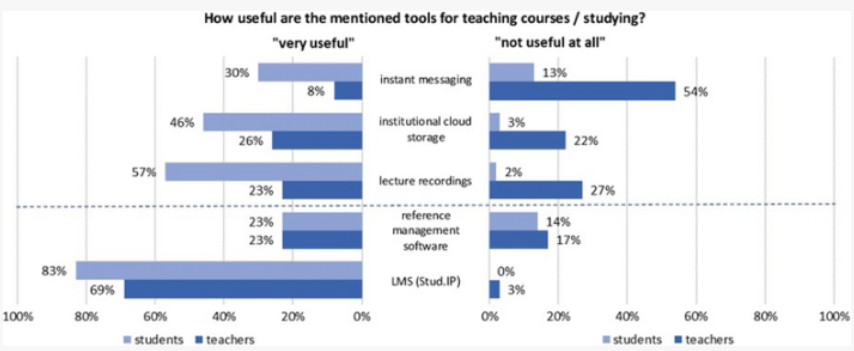
Comparison of teaching and learning tools (Bond, Marín, Dolch, et al. (2018)

What guidelines apply for accessible and intuitive content development?

Web content accessibility guidelines (WCAG 2.1/W3C)
European Union accessibility act
Web accessibility guidelines (Australia)
Proposed changes to web standards (New Zealand)
TEL tests the seasoned

I recently presented at the International Society for the Scholarship of Teaching and Learning (ISSOTL) and Tertiary Education Research New Zealand (TERNZ) conferences on my experience with connectivist, massive open online courses (MOOCs). The experiment with setting up and facilitating a mini open online component (mooc) of a course turned into a “connectivist disconnect.”

References:

Datt, A. (2014)The Connectivist Disconnect. Paper presented at Tertiary Education Research in New Zealand (TERNZ), Auckland, New Zealand. 26 November – 28 November 2014. [Online]
Datt, A. K. (2014)Casting a connectivist stone to generate networking ripples-cMOOCs and elearning professional development. Paper presented at International Society for the Scholarship of Teaching and Learning Conference, Quebec City, Canada. 22 October – 25 October 2014. Nurturing Passion and Creativity in Teaching and Learning. [Online]

Continue reading

Connections: MOOCs, CoPs and the conversational framework

How can the conversational framework influence the design of a cMOOC? Can a cMOOC be an advantage for elearning professional development? Can rethinking the classroom in the digital age be a good example of a cMOOC where the aim is to provide access, increase flexibility while supporting the development of a community of practice where ideas and experiences are shared among individuals who may maintain contact beyond the course. This will be the focus of my design of the mooc on rethinking the classroom-every aspect of the course will be largely dependent on the connection and communications on the course. The Personal Knowledge Management (PKM) skills model will still come in handy as there needs to be initiative and motivation for enrolling and maintaining a presence in the course…

Managing digital repositories

Digitool, an existing digital repository that is available through the University Library is currently being trialled.  Initially it will be used to store and catalogue a range of digital resources around the teaching themes for use in BIOSCI100 & 100G. The Dublin core is used to standardise the metadata descriptors. In designing the digital repository, the team is mindful of issues around copyright and access.  The project will investigate the potential of this repository as a teaching resource and the practicality of maintaining and building on such a system in the longer term.  It will also consider the long term costs for investment in such a system and likely usage by the staff within the School of Biological Sciences.

Continue reading

Generation “MySpace”

Social networking and its impact on students and education

This was my first overseas seminar since joining the University of Auckland as an academic in Technology Enhanced Learning. The seminar – focused on social networking – began with Dr. Dahle Suggett raising important issues around social networking and its impact on the social and emotional wellbeing of our youth. According to him, social networking begins a new era of cultural management where it becomes essential for educators and school administrators to plan the management of the social aspects of technologies. Many schools and universities end up blocking the access to tools such as ‘YouTube’ and ‘MySpace’. Is this the right approach? How do schools respond to students’ use of advanced technologies?

Affordances of Web 2.0

Keynote by danah boyd
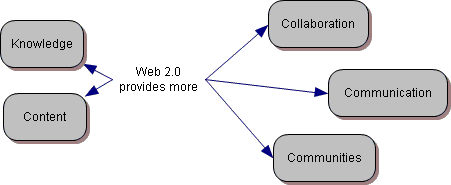
Networked publics concept began with the inception of Usenet in 1979. Web 2.0 has provided more opportunity for networking in the public sphere with the use of modern social networking tools.

Continue reading