Numerous sources and forms of information on the web can overwhelm even the most digitally literate learner. Digital literacy and citizenship become critical as we foray into higher levels of technology integrated learning and work practices. How do we facilitate purposeful web-based inquiry in an engaging way?

In this project, I used a WebQuest – technique introduced by Bernie Dodge in the late 90s – to guide Pharmacy Practice students to skillfully access, use and share information from the web to complete a group assignment. Designed and presented as a scenario online, the assignment provided students an opportunity to collaborate flexibly on their project report and presentation.
A number of tools were cohesively used:
course website – for information and guidance on the assessment task.
wiki – to serve as a collaborative workspace for the process, monitored for participation and engagement by the teacher.
social bookmarking – to encourage critical analysis and transparent sharing of literature and references. This added a competitive streak which was not appreciated by some students.
Similar approach was successfully used for authentic activities in Music courses:
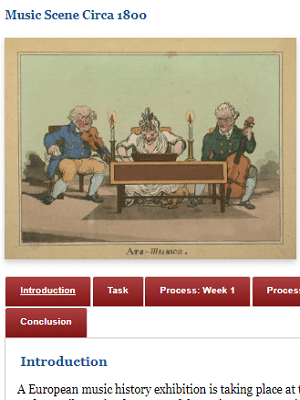
Screenshot of Music History WebQuest 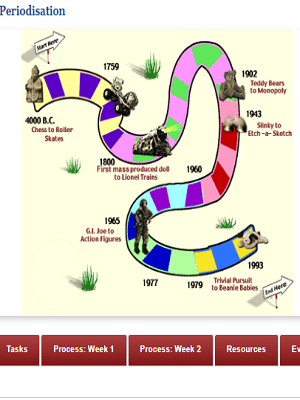
Screenshot of Periodisation WebQuest activity
For further reference:
Datt, A. K., & Aspden, T. J. (2011). Leveraging technology for engaging learning design. In G. Williams, N. Brown, M. Pittard, B. Cleland (Eds.) Ascilite 2011 : Changing demands, changing directions : Proceedings of the Australian Society for Computers in Learning in Tertiary Education Conference, 331-341. Hobart, Australia: University of Tasmania. [Online]
Datt, A., & Aspden, T. (2015). Motivating learning and skills development in Netizens. In C. Koh (Ed.) Motivation, leadership and curriculum design: Engaging the Net Generation and 21st century learners (pp. 63-74). Singapore: Springer. 10.1007/978-981-287-230-2_6
A review of the approach on the ICT Enhanced Learning and Teaching’s Blog
 Ashwini Datt