Category Archives: Personal

Everyday life events of significance

The RIGHT to write

Reflecting on my experience in ACADPRAC 704: Research Writing – a course which is part of my PGCert Academic Practice journey.

Introduction
Most important concerns of my early career publishing are the confidence to express my ‘voice’ and develop a preferred style.  Part of the issue is having the ability to identify and capitalise on the existing strengths of my writing. The journey in ACADPRAC 704 became the rite of passage into writing for me. Taking a bullet train to arrive at the destination much quicker than what the usual journey would have taken. As a budding writer, I had three objectives:
To make use of the increased awareness of research writing – politics, pleasure and style – and develop as a research writer.
To develop a template for my style and a psychological approach to publication that will boost my confidence and success in publishing.
To join a community of practice (CoP) within 704 and/or the Centre for Learning and Research in Higher Education (CLeaR) to become more disciplined and productive in writing through support, advice and feedback.
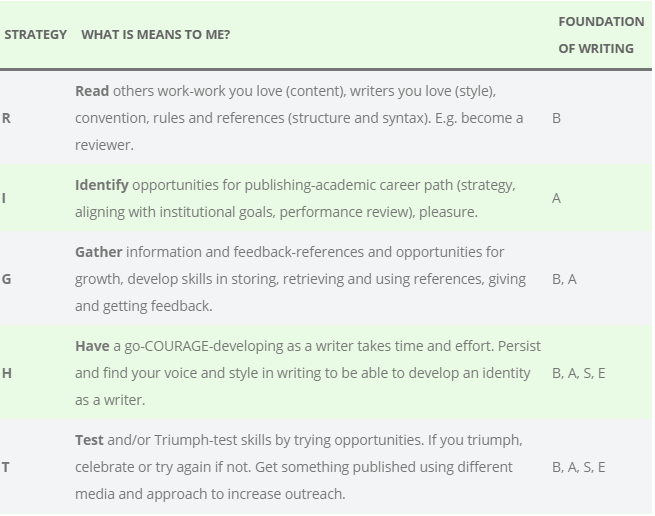
Aligning my strategy (RIGHT) to the foundations (BASE) of writing. Key: B-behavioural, A-artisanal, S-social, E-emotional
Continue reading

Dressing and styling

A search on writing, dressing and style, revealed a rather humorous, unrelated article on styling and dressing, in the sense of, you guessed it, fashion! What resonated with me, however, was the implied message in the article. Irrespective of the designer style or label, the height of the wearer has an impact on the overall impression of the garment. Much like the stage we are at in our research career, has an influence on the liberty we have to make bold statements with our writing. This post is very much a reflection of my own writing journey, not research writing per se but writing in general.

Continue reading

Academic life: finding the balance

This is a reflective post on the concept of balance (wellbeing and productivity) introduced in ACADPRAC 702: Academic Citizenship (PGCert Academic Practice).

“…for students it would be better to be clear about the purpose of what they are studying and identifying the high-priority areas rather than simply reading more or reorganising their notes” (p244). Who would dare tell this to their students? Aren’t we in the process of churning out mass graduates to keep our revenue lines healthy?

Kearns & Gardiner (2007)

Is it time well spent? The relationship between time management behaviours, perceived effectiveness and work related morale and distress in a university context (Kearns & Gardiner, 2007)
I really liked this paper and have already started thinking about how I can get onto my PhD without further procrastination! Procrastination is considered a “bad habit” (p236). The standout value of this paper was the fact that they had given student life some consideration and balanced the view on workloads by comparing students and teachers alike. “Today’s students will tell you that, with demands of lectures, study… there is barely any time for life” (p236). However, what intrigued me most was the behaviour that they prioritised most ‘having a clear purpose in your career’. I am sure, early career academics would agree with me that in the early days, irrespective of the focus and sense of purpose one has, it comes down to sink or swim and time management becomes an unknown issue. I also thought that being organised was an all-encompassing behaviour rather than something at the bottom of the pyramid. For example, for me planning and prioritising is part of being organised.

Continue reading

Joining the dots: networking, capacity and policy

While thinking about the PhD – value of networks in developing capacity – I explore the key features of our university policy on staff professional development and how it relates to academic citizenship.

University is committed to providing its academic staff with the opportunity to become excellent teachers and leading scholars and researchers in their fields, and to developing their managerial, leadership and technical abilities. One of the applied principles is that orientation and induction; mentoring; training as a lecturer/tutor; training for academic heads; and development in academic leadership, are important for the development of good practice. Professional development includes: technical skill development to help academic staff to teach or research more effectively; mentoring to provide staff with advice and support and a sounding board for self-review and appraisal; and work culture development.

Continue reading

Writing about my teaching

A Teaching Profile focuses on the core values, signature pedagogies, personal style and beliefs in our teaching. Various ways to formulate a readable profile include the use of metaphorsillustration or drawing, lists of guiding values, attitudes or  ethicssignature pedagogies, past influential experiences and details of student expectations and achievements.

What is my Teaching Philosophy and Approach?
As an early career academic, I aspire to be an inspirational and research-informed, responsive teacher. I always think of teaching and learning design as a smart balancing act. Very much like a trapeze artist, you need to be brave and bold to take risks, and accept that one fall will potentially inflict long-term damage but recovery is possible. The whole experience is important to perfect the act, if perfection is at all possible. My teaching philosophy and aspirations are best represented by a famous Richard Bach (n.d.) quote: You teach best what you most need to learn. With the rapidly changing technologies and transforming classrooms, teaching in the area of elearning is always a personal learning experience. There is a considerable amount of balancing required based on the context, skills and experiences of target audiences, access and availability of media and technologies and above all the learning approach. I prefer to take an eclectic approach to “use what works” (Mergel, 1998) and do frequently draw on a combination of learning theories as and when appropriate.

Continue reading