Category Archives: EdTech

Educational technologies and innovation

First reflections on the new ACADPRAC 703

Off to a ‘not so great’ start as there are many enrollments issues to be sorted. However, considering the class sizes I have had before, 2 being the minimum, I think having 5-8 people this time is a real bonus. Panic has set in over student pages as I have realised there are glitches in the system that allow student editors to see the hidden pages. Though they cannot edit or see the content-which is displayed as work in progress- I feel it is not a professional look. Also, linking to unpublished sites in image map makes it go to edit view where access is compromised for hidden content. Answered the first student query as I did not have access to the right CECIL instance of the course, I couldn’t see the students enrolled. Then there was the palaver over enrollment caps, ACADPRAC 703 somehow had a capacity for 5 students on SSO which isn’t correct at all. If anything there could be 50 students which I rightly pointed out to admin and they realised it was a typo!
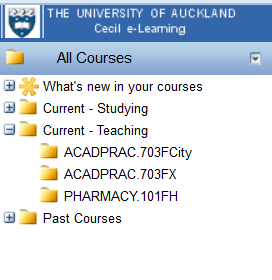
This confusion between ACADPRAC 703F City 2014 and ACADPRAC 703FX 2014 certainly exists and needs to remedied through CECIL admin. I finally got access to the correct course.
Design aspirations:
>> interactive course with focus on peer-peer communication and collaboration.
>> input from students to negotiate the assessment 2 format and timing.
>> clear guidelines on what is required and what is desirable but not essential e.g. links to Fellowship and CLeaR Lights programme.
>> information to lead into further exploration and personalisation of the learning experience.
>> journal for student reflections, collaborative glossary and student pages to create an online presence

Continue reading

Writing about my teaching

A Teaching Profile focuses on the core values, signature pedagogies, personal style and beliefs in our teaching. Various ways to formulate a readable profile include the use of metaphorsillustration or drawing, lists of guiding values, attitudes or  ethicssignature pedagogies, past influential experiences and details of student expectations and achievements.

What is my Teaching Philosophy and Approach?
As an early career academic, I aspire to be an inspirational and research-informed, responsive teacher. I always think of teaching and learning design as a smart balancing act. Very much like a trapeze artist, you need to be brave and bold to take risks, and accept that one fall will potentially inflict long-term damage but recovery is possible. The whole experience is important to perfect the act, if perfection is at all possible. My teaching philosophy and aspirations are best represented by a famous Richard Bach (n.d.) quote: You teach best what you most need to learn. With the rapidly changing technologies and transforming classrooms, teaching in the area of elearning is always a personal learning experience. There is a considerable amount of balancing required based on the context, skills and experiences of target audiences, access and availability of media and technologies and above all the learning approach. I prefer to take an eclectic approach to “use what works” (Mergel, 1998) and do frequently draw on a combination of learning theories as and when appropriate.

Continue reading

Book review

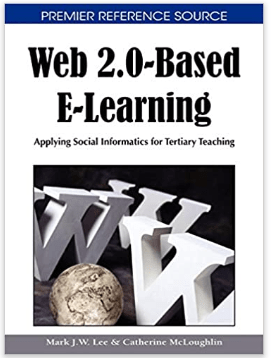
Lee, M. J. W. & McLoughlin, C. (Eds.). (2011). Web 2.0 based elearning: applying social informatics for tertiary teaching. Hershey, PA: Information Science Reference.

Use of Web 2.0* tools in contemporary tertiary education is debatable. While technology advocates (e.g. Marc Prensky) recommend blanket adoption; researchers (see Kennedy et al. 2010) are concerned about the adaptability of social technologies in educational contexts. This book, through various authors, and their respective contexts, provides an informed and balanced view with sections dedicated to theory, practice and future directions of the educational application of Web 2.0 tools.

Web 2.0 based elearning: applying social informatics for tertiary teaching. Hershey
Book reviewed: Web 2.0 based elearning

The first section covers emerging paradigms and innovative theories in web-based tertiary teaching since Web 2.0 tools and practices are challenging and redefining scholarship and pedagogy. The idea is that the emergence of new tools by itself will not revolutionise education but its affordances provide the opportunity to: a) create new models for education for the knowledge society and, b) innovate tertiary teaching and learning.

Affordances of Web 2.0 tools are well illustrated through case studies and exemplars of evidence-based practices in section two. As a practitioner, this section was most useful for me. The authors refrain from pushing the technology agenda but address the important decision making questions like what to use, how and when. Pedagogical relevance is emphasised with reference to learners’ digital literacies and personal knowledge management skills and teachers’ capabilities and capacities.The final section addresses the challenges in educational applications of Web 2.0 due to the theoretical gap in literature and concludes with two approaches to harnessing the power of Web 2.0 in education:
1. Applying social web practices to facilitate greater dialogue and sharing of learning and teaching ideas.
2. Using metaphors as a mechanism for understanding educational application of Web 2.0 technologies.
Overall, this book is a great reference for anyone contemplating the use of Web 2.0 tools in education hence a valuable addition to the reading list.

*A second generation, more personalised, communicative form of the World Wide Web that emphasizes active participation, connectivity, collaboration, and sharing of knowledge and ideas among users. Also referred to as the “read/write Web” (Price, 2006; Richardson, 2006).

Managing digital repositories

Digitool, an existing digital repository that is available through the University Library is currently being trialled.  Initially it will be used to store and catalogue a range of digital resources around the teaching themes for use in BIOSCI100 & 100G. The Dublin core is used to standardise the metadata descriptors. In designing the digital repository, the team is mindful of issues around copyright and access.  The project will investigate the potential of this repository as a teaching resource and the practicality of maintaining and building on such a system in the longer term.  It will also consider the long term costs for investment in such a system and likely usage by the staff within the School of Biological Sciences.

Continue reading

Generation “MySpace”

Social networking and its impact on students and education

This was my first overseas seminar since joining the University of Auckland as an academic in Technology Enhanced Learning. The seminar – focused on social networking – began with Dr. Dahle Suggett raising important issues around social networking and its impact on the social and emotional wellbeing of our youth. According to him, social networking begins a new era of cultural management where it becomes essential for educators and school administrators to plan the management of the social aspects of technologies. Many schools and universities end up blocking the access to tools such as ‘YouTube’ and ‘MySpace’. Is this the right approach? How do schools respond to students’ use of advanced technologies?

Affordances of Web 2.0

Keynote by danah boyd
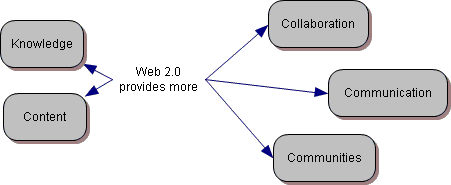
Networked publics concept began with the inception of Usenet in 1979. Web 2.0 has provided more opportunity for networking in the public sphere with the use of modern social networking tools.

Continue reading