Category Archives: EdTech

Educational technologies and innovation

ITEL: inclusive technology enhanced learning

Related project: Technology for equitable learning opportunities and design
(Learning Enhancement Grant 2019-2020)
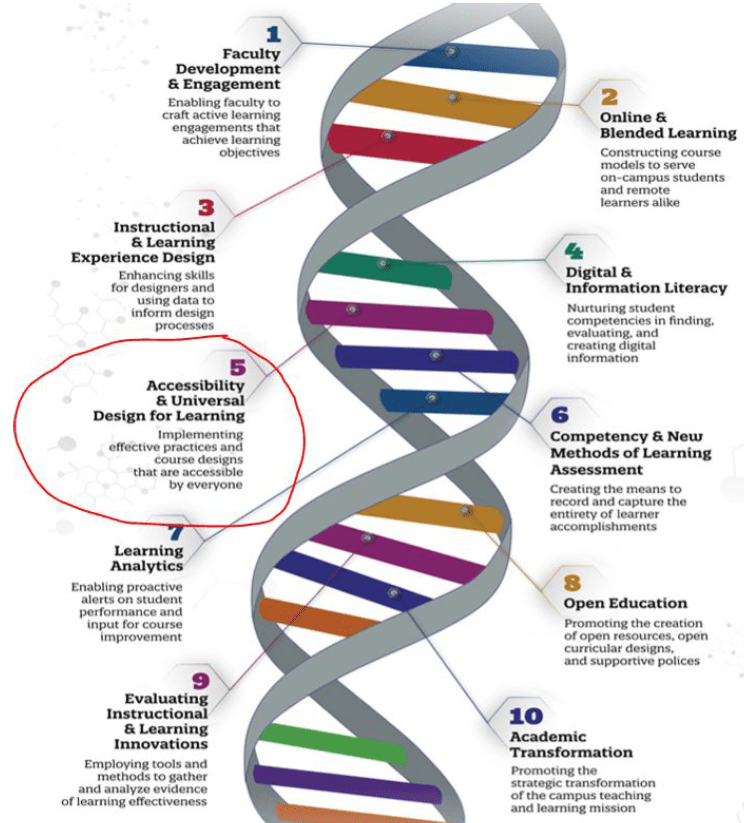
Top 10 issues in higher education in 2019 (EDUCAUSE)

What can technology do to create barriers to learning? Seems like plenty… EDUCAUSE in its 2019 elearning initiative, identified accessibility and Universal Design for Learning (UDL) as a key teaching and learning issue. Our presentation (2019 Scholarship of Technology Enhanced Learning conference) on the core consideration for inclusivity in design – audience, tools, content and legislation – opened up some interesting discussions. Many at times we make assumptions about our learners and their digital skills; accessibility and usability of tools; content creation quailty (re-packaging rather than re-purposing) and the law (accessibility standards). How can we ensure that our learning designs and content facilitation through technology offers equitable learning experiences? 

What do our learners find useful?

Even though students in Australia and New Zealand report high levels of digital activity than UK students, they agree that technology can have negative impacts on their studies. Unless designed well and integrated into the core learning outcomes, these learners rather not have digital technologies used in their courses (Beetham, Newman & Knight, 2019).

What tools are useful?

The use of digital technologies don’t always lead to creative, collaborative, participatory and hyper-connected practices. Henderson, Selwyn and Aston (2017) indicate that rather these are the activities, practices and processes that students feel compelled to undertake in order to ‘do’ university.

...many of the reportedly ‘educational’ benefits of digital technology…are more accurately described as concerned with the ‘logistics’ of university study rather than matters related directly to ‘learning’ per se.

Henderson, Selwyn & Aston (2017)

Bond, Marín, Dolch, et al. (2018) reported differences in how learners and teachers perceive the usefulness of tools such as lecture recordings, the learning management system (LMS) and reference management systems. For example, close to a quarter of all teachers they researched, thought lecture recordings were not useful but close to 50% of the students found them useful.
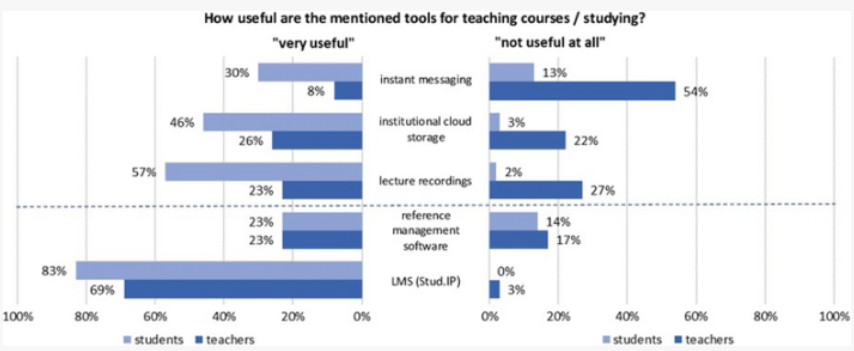
Comparison of teaching and learning tools (Bond, Marín, Dolch, et al. (2018)

What guidelines apply for accessible and intuitive content development?

Web content accessibility guidelines (WCAG 2.1/W3C)
European Union accessibility act
Web accessibility guidelines (Australia)
Proposed changes to web standards (New Zealand)

TEL tests the seasoned

I recently presented at the International Society for the Scholarship of Teaching and Learning (ISSOTL) and Tertiary Education Research New Zealand (TERNZ) conferences on my experience with connectivist, massive open online courses (MOOCs). The experiment with setting up and facilitating a mini open online component (mooc) of a course turned into a “connectivist disconnect.”

References:

Datt, A. (2014)The Connectivist Disconnect. Paper presented at Tertiary Education Research in New Zealand (TERNZ), Auckland, New Zealand. 26 November – 28 November 2014. [Online]
Datt, A. K. (2014)Casting a connectivist stone to generate networking ripples-cMOOCs and elearning professional development. Paper presented at International Society for the Scholarship of Teaching and Learning Conference, Quebec City, Canada. 22 October – 25 October 2014. Nurturing Passion and Creativity in Teaching and Learning. [Online]

Continue reading

Strategies to engage online

While hastily trying to finish off a proposal on the mooc course design and challenges (which will influence the design itself) for a book chapter,  I’ve come to a realisation that my online students (fellow academics) are not really present in the course. Yes, they log in and out and do post a few messages sporadically in response to the activities, I still am not getting the level of engagement I would like. Going back to my masters research on the types and levels of interaction within the course, I am a bit worried if this group will do well on a collaborative task. Therefore, I have planned a synchronous session that will help me develop more of a presence and be the facilitator of learning in the course. I have invited students to join in with questions etc and also come prepared to summarise the first topic of digital citizenship. I will record the session for the benefit of others in the course.

Reading on the MOOCs phenomenon and the diverse ways in which learners and teachers alike respond to it, is very intriguing at this stage as I plan the implementation of the 703 mooc. A meeting with the copyright officer and the library liaison is high on the cards as I need to clarify what is acceptable and can be legally shared through the mooc. The pieces of the theoretical puzzle are slowly getting solved as I discover more literature on the pedagogy of MOOCs.

MERLOT Journal of Online Teaching and Learning and MOOCs forum seem to be excellent sources of information on the current status and application of the MOOCs initiative. What’s also reassuring is that cMOOCs and their design is what is relevant in my approach to mooc design, development, implementation and integration in ACADPRAC 703. cMOOCs are influenced by well known learning theories and concepts such as Socio-constructivism that has its roots in social learning, Connectivism that is informed by network theory and Community of Practice (CoP) model that is relevant in academic professional development initiatives.

Connections: MOOCs, CoPs and the conversational framework

How can the conversational framework influence the design of a cMOOC? Can a cMOOC be an advantage for elearning professional development? Can rethinking the classroom in the digital age be a good example of a cMOOC where the aim is to provide access, increase flexibility while supporting the development of a community of practice where ideas and experiences are shared among individuals who may maintain contact beyond the course. This will be the focus of my design of the mooc on rethinking the classroom-every aspect of the course will be largely dependent on the connection and communications on the course. The Personal Knowledge Management (PKM) skills model will still come in handy as there needs to be initiative and motivation for enrolling and maintaining a presence in the course…

Curse of technology? More reflection on ACADPRAC 703

Apart from all the enrollment concerns, I have begun to feel that most of the students are yet to feel confident online. At least one of them is fully engaged (having completed their student page!) and raring to go while the rest are very cautious. It is hard to find the balance between catering to the needs of the very active and those who are lurking not because they don’t want to engage but just haven’t found the confidence to put their thoughts out there. A good last minute teaching strategy for me was to hold back the summary of topic 1 until all students have had a go at the readings and have posted a response to the online activity. Have decided to publish the announcements using the comments feature as it is auto subscribed. There was bit of a drama over where it should appear on the site and whether the comments bubble should be active when it is on the homepage. We tried to suppress the bubble but realised that the ajax code does not behave and the like button disappears after the first person has used it! Now, a dedicated page called announcements has been created and that has the full comment feature.