Author Archives: ashwinidatt

Unknown's avatar

About ashwinidatt

I am an experienced higher educator, researcher and pragmatic innovator. My interest and expertise are in contemporary issues in education including inclusive blended, online and networked learning, social media, digital citizenship and networking for capacity development.

Ascilite 2023

Great to finally be reconnecting with colleagues from Australia after 7 years of absence from Ascilite. 2023 has been a good year for collaborative research with colleagues from Auckland University of Technology, Massey University, University of Waikato and University of Canterbury. Look forward to our symposium presentation on Students’ Online Learning Experiences during emergency remote teaching.

New course alert!

Excited to be developing a new fully online special topic paper for the UoA #clined programme on advanced elearning in clinical education. This paper intends to amalgamate the lessons learnt from remote teaching/learning during #covid19pandemic, with more established and tested means of technology integration in clinical teaching. There are so many reasons why the timing is opportune. A curriculum framework transformation is underway at the university, #pivotonline has surfaced promising options to interact and engage with students flexibly and the best way to appreciate learning online is to step into an online learner’s shoe. Not all changes implemented during #pivotonline may be suitable in perpetuity but there are aspects of online learning that might enable useful pedagogical shift in medical education.

What remains to be seen is whether COVID-19 provided the experience, vision and courage for medical education to change, or whether the old barriers will rise again when the pandemic is over.

Binks et al., 2021

Keeping the learner front and centre

Research collaboration between the University of Auckland, Waikato University, Canterbury University, Auckland University of Technology and Massey University (Ethics reference: FEDU036/20)

Whether we like it or not, universities are “going online” in response to COVID-19. Those of us working in the area of educational technologies might have been hoping for such a shift in contemporary higher education but no one anticipated such unprecedented change in such a short time. Organisations like EDUCAUSE emphasize the difference between carefully planned online learning experiences and courses offered online in response to a crisis or disaster (Hodges et al 2020). Students are facing multiple demands (many of which will persist) in the current context – e.g. access, financial, experience and orientation to learning online, motivation and diminished interaction with peers.
Emergent literature tends to be written from a teacher/lecturer point of view, focusing on how to make a rapid shift to online learning, and how to teach online. Missing from this literature is nuanced consideration of student perspectives. How teachers teach online, and how students experience and learn online can be poles apart (Forbes & Gedera, 2019), necessitating explicit attention to how students experience online teaching and learning. In particular, online students may engage in different ways (Brown et al, 2019).
As a team of educators interested in digital literacy and inclusive learning, we have embarked on a research project to learn from NZ university students’ perspectives and experiences of online learning during covid19. This project will fill the gap in current literature, emerging from US and the UK.

References

Brown, C., Davis, N., Eulatth-Vidal, W. (2019). Student engagement in flexible and distance learning in Aotearoa New Zealand. In A. Kamp (Ed). Education Studies in Aotearoa: Key disciplines and emerging directions. NZCER.
Forbes, D. L., & Gedera, D. S. P. (2019). From confounded to common ground: misunderstandings between tertiary teachers and students in online discussions. Australasian Journal of Educational Technology, 35(4), 1–13. https://doi.org/10.14742/ajet.3595
Hodges, C., Moore, S., Lockee, B., Trust, T & Bond, A. (2020) The Difference Between Emergency Remote Teaching and Online Learning. Educause Review https://tinyurl.com/rekxcrq



Lets be critical: Re-examining technology affordances and digital literacies for professional education

A recent article by Smith, Kahlke and Judd (2020), reminds me of how almost a decade ago now, a colleague and I created an engaging learning design for a competency based programme: combining technology affordances, pedgagogy and digital literacy. We went the extra mile in planning and designing for the proper integration and use of technologies in the Pharmacy Practice programme, without making any assumptions about students’ digital literacy. Our approach (see Datt & Aspden, 2011) was based on the contributing elements of design for socio-constructivist learning environments: authenticity, motivation, scaffolding and skills development. We too focused on “two key questions: (1) what affordances are offered by a given technology that will support learners in developing their professional competencies, and (2) what broad range of knowledge and skills do learners require in order to effectively integrate a technology in their learning and practice?” (Smith et al., 2020, p.6)

Continue reading

Covid19, networks and capacity to teach with tech

We have all been compelled to consider remote learning as a legitimate alternative to on-campus teaching. For the advocates of technology integrated learning (fully online or blended) – who have chipped away at good designs for learning with educational technologies – it was a triumph and a long time coming. Educators who were yet to be convinced about the possibilities of online or digital learning, quickly adopted remote learning opportunities out of necessity. How did we achieve such a feat? Be it new ways of delivering or facilitating learning, we all had to build our capacity to do so in a short period of time. Welcome the #pivotonline movement.

#pivotonline resources:
Twitter; #pivotonline
AACE: Stories from the field ebook
Linkedin group: Moving HE teaching online
Online Learning Consortium: Faculty Playbook
Coursera: Learning to teach online
OpenLearn: Take your teaching online
Youtube: Open teach
University of Auckland: Remote learning
Googledoc: Hybrid learning; Higher Ed Guidance
Public network: Keep teaching
Blog: Edvisor community
Global support group: #OER4Covid
Asian Journal of Distance Education: Diverse perspectives
EDUCAUSE: Teaching continuity

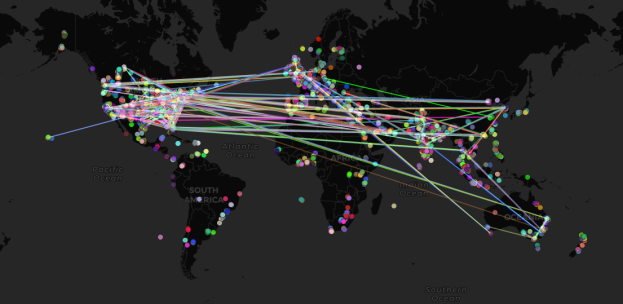
#Pivotonline is my doctoral research playing out in real-time, educators networking to build their capacity for teaching with technologies. If we consider a platform like Twitter, we can see how these networks form and flourish – with short and long term connections. The image here is of the publicly available Tweets using pivotonline hashtag. What do these connections mean and what value do they hold for the educators involved? What benefits and challenges did these new ways of learning present for our students?