A recent article by Smith, Kahlke and Judd (2020), reminds me of how almost a decade ago now, a colleague and I created an engaging learning design for a competency based programme: combining technology affordances, pedgagogy and digital literacy. We went the extra mile in planning and designing for the proper integration and use of technologies in the Pharmacy Practice programme, without making any assumptions about students’ digital literacy. Our approach (see Datt & Aspden, 2011) was based on the contributing elements of design for socio-constructivist learning environments: authenticity, motivation, scaffolding and skills development. We too focused on “two key questions: (1) what affordances are offered by a given technology that will support learners in developing their professional competencies, and (2) what broad range of knowledge and skills do learners require in order to effectively integrate a technology in their learning and practice?” (Smith et al., 2020, p.6)
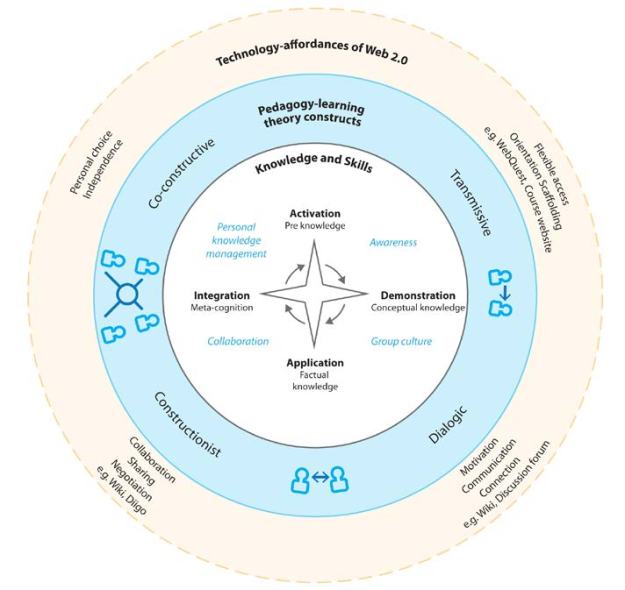
“The types of thinking and processes that students needed to engage in to complete their course requirements was paramount in identifying the appropriate blend of technologies. The position of technology in the periphery of the design is testament to the fact that technology does not drive learning but it does have affordances that can be built on to provide better learning experiences. In addition to this, technologies are rapidly changing hence the broken line. Knowledge and skills are at the core of the learning design. In this case, technology enabled us to provide flexible access to the course content ensuring equity in access and facilitated the development of digital literacy, group culture and [Personal Knowledge Management] PKM skills. The latter was possible through linkages to the course assessment that provided some degree of motivation for students to engage sufficiently.”
Datt & Aspden (2011, p.334)
With “integration of technology to provide flexible access and encourage engagement while facilitating the development of knowledge management skills” at its core, our model is akin to Smith et al. (2020), which focuses on “facilitating learning outcomes and affordance alignment in professional contexts” (p.7). For example, knowledge and skills element of our model aligns well with their “domains of digital literacy”; technology affordances are a clear match to “core affordances” and their “professional competencies” could be mapped onto pedagogical considerations of our approach. I particularly like how they explicate the domains of digital literacy and align them with the affordances of technology, to support pedagogically sound design of professional education. Undoubtedly, both our models draw on the Technology, Pedagogy and Content Knowledge (TPCK) framework, which has a broader remit of transforming teaching with technology.
In any case, it is great to see the revival of critical thought on learning in the digital age and development of digital literacy/competency that is learner age-agnostic and devoid of assumptions about digital skills.
References
Datt, A. K. & Aspden, T. J. (2011). Leveraging technology for engaging learning design. In
G.Williams, P. Statham, N. Brown, B. Cleland (Eds.), Changing Demands, Changing Directions. Proceedings ascilite Hobart 2011. (pp.331-341).
http://www.ascilite.org.au/conferences/hobart11/procs/Datt-full.pdf
Smith, E. E., Kahlke, R., & Judd, R. (2020). Not just digital natives: Integrating technologies in professional education contexts. Australasian Journal of Educational Technology, 36(3), 1-14. https://doi.org/10.14742/ajet.5689
 Ashwini Datt