Reflecting on my experience in ACADPRAC 704: Research Writing – a course which is part of my PGCert Academic Practice journey.
Introduction
Most important concerns of my early career publishing are the confidence to express my ‘voice’ and develop a preferred style. Part of the issue is having the ability to identify and capitalise on the existing strengths of my writing. The journey in ACADPRAC 704 became the rite of passage into writing for me. Taking a bullet train to arrive at the destination much quicker than what the usual journey would have taken. As a budding writer, I had three objectives:
To make use of the increased awareness of research writing – politics, pleasure and style – and develop as a research writer.
To develop a template for my style and a psychological approach to publication that will boost my confidence and success in publishing.
To join a community of practice (CoP) within 704 and/or the Centre for Learning and Research in Higher Education (CLeaR) to become more disciplined and productive in writing through support, advice and feedback.
Below I elaborate how, and to what extent, I have achieved each of these inter-dependent objectives.
Objective 1: Awareness of research writing – politics, pleasure and style.
As the ACADPRAC 704 journey progressed, I felt myself blossom into a more conscious writer with an increased awareness of the politics, pleasure and style of writing. The politics and pleasures of writing bring with it some interesting challenges for me. Though the politics seems an obstruction to my pleasurable writing, I have begun to acknowledge its importance in career progression. It is absolutely crucial to have a strategy for productive writing while developing a personal voice and style. For example, identifying and prioritising high impact outputs ahead of publications of personal interest to boost the research profile. Through the seminars, I appreciated the opportunity to get back to the basics of writing. Identifying and maintaining a logical flow of the narrative, smart sentencing to energise the prose for a captive audience, and strategizing for impact and productivity are useful and practical skills to acquire.
Sword’s (2009) manifesto on style, which explicates the features of a good article, is something I intend to aim for: an interesting and concrete title; engaging opening paragraph; story telling; jargon free prose; individualistic voice; hint of relevant inter-disciplinary links; and elegance and craft in sentencing form a great practical foundation for writing for early career academics. This piece is my attempt at a jargon free, individualistic story with an interesting title that hints on my transition from the Sciences to the Humanities.
Academic training in a discipline makes us susceptible to being indoctrinated in the norms/rules of that discipline. With my scientific background, I am still quite formulaic in my approach. I find myself challenged to adopt a unique style that’s influenced – but not determined – by writing conventions. As my awareness of stylish writing increases, I am beginning to nurture my creative flair. The fulfilment of the first objective is further demonstrated next, via the strategy and approach that I have developed.
Objective 2: Template and psychological approach
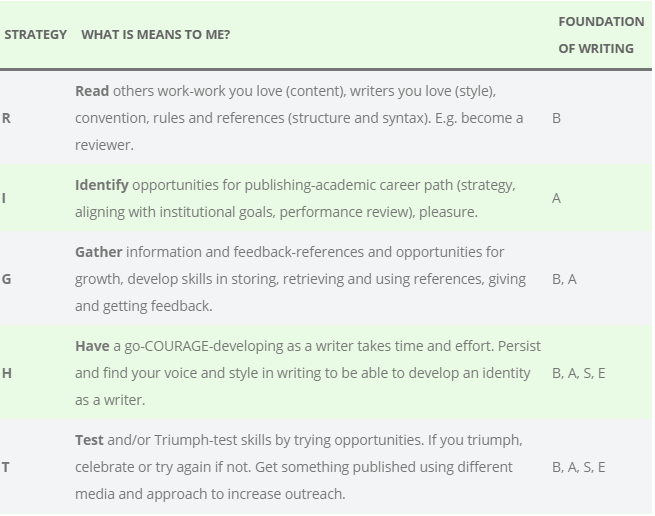
The RIGHT strategy depicts my metacognitive approach to becoming a more productive writer. Aligning my individual approach to the four foundational elements of writing – behavioural, artisanal, social and emotional (BASE) – makes it more concrete. The ‘RIGHT’ strategy is practically focussed and designed to help me balance the politics and pleasure of writing, be more productive by prioritising outputs and becoming time efficient. All this has demanded a change in behaviour and emotional engagement. I have begun to take writing as an integral part of my academic life rather than a chore or a hobby (Murray, 2013).
Comfort and social skills must be complemented by momentum and regimen for productive writing. I have refrained from writing and editing at speed electronically because being a digital native engaged in elearning, the electronic medium and the immediacy associated with it, presents a point of exhaustion rather than excitement. Approaches like shut up and write and the pomodoro techniques fuel my anxiety, which according to Murray (2013) can cause cognitive disengagement. However, dedicating a time and place for writing has helped me integrate it better into my schedule. For example, I have begun to write freely every Wednesday morning, following an exercise session which gives my mind clarity and enhanced focus. I have been surprised at how much pleasure Wednesday morning’s writing now brings to me. Just being able to recognise that I free write best when I am using my individualistic voice and using old technology such as pen and paper rather than electronic means has made me a surprisingly productive writer.
I have gone through the first three stages of the ‘RIGHT’ strategy quite quickly while writing the assessment pieces. As Williams (2006) points out, there is a moment and time for getting the writing done so you can revise it later. This is exactly what I can achieve in this time frame for upcoming articles. However, having a deadline will help me avoid that infinite cycle of revision for clarity and style. I do not intend to run out of “energy, interest, or time” (Williams, 2006, p5). The ability to recognise strengths and accept rejection requires emotional tenacity and a degree of social engagement. I feel, only when I have become more mentally prepared for, and seek community in writing, I might develop a more defined individualistic voice and style. My third and final objective is focused on the social aspect of writing-being part of a writing CoP.
Objective 3: Community of practice for discipline and productivity.
In his programme for facilitating scholarly writing, Boice (2006), points out the importance of a “dual locus” approach. The theoretical basis of writing favoured in the class setting, needs to be extended to embrace more practical aspects that include writing socially. Communicating with a critical friend in, and outside the discipline and getting review and feedback on actual pieces of writing. Support, advice and reassurance, are things that I depend on to be consistent in my writing endeavours. Therefore, I will actively seek these as part of a CoP in writing. A good start is the research triads within our centre.
Finally, it is useful to think that the future might present its unique challenges in the sense of differing workloads, time on task, quality of feedback from colleagues or critical friends and career progression. Beginning a PhD (soon) while working full-time, the main purpose of developing writing is impact and influence in my area of research. Identifying the audience first before writing will ensure varied outlets for the writing. For example, continuing scholarly writing on a reflective blog on ‘learning to teach’ while contemplating publishing in a highly reputable international journal seems to strike a reasonable balance between pleasure and politics of writing while maintaining productivity. Fulfilling the objectives of ACADPRAC 704 has not only broadened my horizon for writing but opened my eyes to recognise, acknowledge and build on my developing writing skills. The most standout achievement of all has been in the process of writing. A change in behaviour resulting in: (1) emotional engagement for the pleasure of writing; and (2) social engagement for progress and refinement of style.
References
Boice, R. (1987). A program for facilitating scholarly writing. Higher Education Research and Development, 6(1), 9-20. Available on line at http://www.tandfonline.com/doi/pdf/10.1080/0729436870060102
Murray, Rowena (2012). “It’s not a hobby’: reconceptualizing the place of writing in academic work” Higher education, 2012).
Sword, H. (2009). Writing higher education differently: A manifesto of style. Studies in Higher Education, 34(3), 319-336. Available on line at http://www.itl.usyd.edu.au/news/pdfs/Sword2009_Writing_HE_differently.pdf
Williams, J. (2006). Chapter 1 of Style: The Basics of Clarity and Grace, second edition. Chicago: University of Chicago Press, 1-6.
 Ashwini Datt